Pay transparency in job postings: share of career-site postings that state pay, by country and platform
In September 2026, 38.8% of 2,059,547 job postings with a description on the company career sites we track stated the pay. 66.1% of the 3,115,990 postings detected that month had a description.
Edition 2026-09 (latest). Pattern version pay-v3-2026-10-31.
Why this study: the law behind it
The EU Pay Transparency Directive (Directive (EU) 2023/970, adopted on 10 May 2023) gives job applicants the right to receive information about the initial pay, or its range, for the position, for example in a published job vacancy notice or before the job interview (Article 5(1)). It also bars employers from asking applicants about their pay history (Article 5(2)); both apply through national law once transposed.
Member states had to transpose the directive into national law by 7 June 2026; several, Germany among them, had not done so by then. Job postings are where applicants look for pay, so this study measures how many postings on company career sites already state it, country by country, edition by edition.
- EU-2715 of 27 member states with published figures23.0% state pay, September 2026
Directive (EU) 2023/970, Article 5: initial pay or its range, for example in the vacancy notice or before the interview; transposition deadline 7 June 2026. Source: EUR-Lex
- Austria56.5% state pay, September 2026
Equal Treatment Act (Gleichbehandlungsgesetz) § 9(2): since 1 March 2011 a job advertisement must state the minimum pay under the collective agreement or the law, and any willingness to pay more. Source: RIS
- Germany15.1% state pay, September 2026
Directive not yet transposed. The Pay Transparency Act of 2017 (Entgelttransparenzgesetz) sets no duty to state pay in job postings. Source: gesetze-im-internet.de
- United States44.9% state pay, September 2026
No federal duty. State and city laws require a pay range in postings, for example Colorado (since 2021), California and Washington (since 2023) and Illinois (since 2025).
- Canada50.5% state pay, September 2026
Provincial laws: British Columbia since 1 November 2023; Ontario since 1 January 2026 for employers with 25 or more employees. Source: Government of British Columbia
- United Kingdom28.9% state pay, September 2026
No legal duty to state pay in job postings.
Legal summary as checked on 8 November 2026; it is not legal advice. The study counts whether a posting states pay; it does not check whether a posting complies with any law, and the shares are not a measure of any law's effect.
Totals for September 2026
Of the analysed postings, 4.3% carry a structured pay field and 34.4% state pay only in the description text.
By country
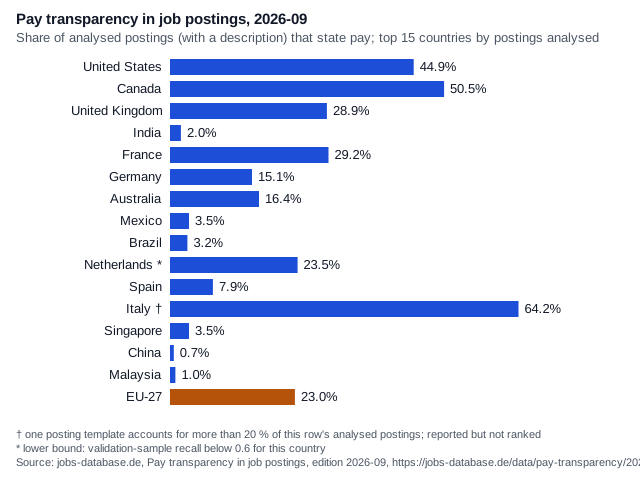
Countries with at least 1,000 analysed postings, at least 20 companies and no company above 30 percent of them, ranked by share stating pay; a row marked † is shown but not ranked. Every share is a share of analysed postings (those with a description).
| Rank | Country | Postings analysed | Companies | Share stating pay | Structured field share |
|---|---|---|---|---|---|
| – | Italy † | 8,426 | 750 | 64.2% | 1.1% |
| 1 | Austria | 2,921 | 309 | 56.5% | 5.6% |
| 2 | Canada | 72,842 | 3,759 | 50.5% | 4.0% |
| – | Puerto Rico † | 1,832 | 197 | 45.4% | 1.7% |
| 3 | United States | 1,212,186 | 32,728 | 44.9% | 5.8% |
| 4 | Georgia | 1,050 | 217 | 31.8% | 10.5% |
| 5 | France | 31,701 | 1,431 | 29.2% | 2.3% |
| 6 | United Kingdom | 50,105 | 3,355 | 28.9% | 2.3% |
| 7 | Netherlands * | 9,235 | 1,052 | 23.5% | 8.9% |
| 8 | Poland | 5,969 | 814 | 20.6% | 2.6% |
| 9 | Ireland | 6,025 | 724 | 19.5% | 2.4% |
| 10 | Australia | 18,504 | 1,338 | 16.4% | 0.6% |
| 11 | Germany | 26,620 | 2,245 | 15.1% | 2.3% |
| 12 | New Zealand | 3,264 | 354 | 13.4% | 0.8% |
| 13 | Israel | 2,415 | 416 | 11.4% | 0.5% |
| 14 | Colombia | 3,965 | 522 | 10.0% | 1.3% |
| 15 | Belgium | 3,648 | 487 | 9.0% | 0.4% |
| 16 | Spain | 8,595 | 969 | 7.9% | 2.2% |
| 17 | Portugal | 2,759 | 398 | 7.9% | 1.6% |
| 18 | Czechia | 1,527 | 317 | 7.5% | 2.2% |
| 19 | Switzerland | 3,777 | 543 | 7.4% | 0.5% |
| 20 | Romania | 2,515 | 316 | 7.2% | 0.6% |
| 21 | Argentina | 1,752 | 393 | 7.2% | 3.9% |
| 22 | Hungary | 2,202 | 290 | 5.8% | 0.7% |
| 23 | Sweden | 2,696 | 403 | 5.2% | 0.5% |
| 24 | Türkiye | 1,458 | 254 | 5.2% | 0.5% |
| 25 | Philippines | 6,785 | 743 | 4.7% | 3.4% |
| 26 | Egypt | 1,739 | 237 | 4.6% | 1.2% |
| 27 | South Africa | 2,618 | 393 | 4.1% | 1.2% |
| 28 | Mexico | 13,991 | 1,059 | 3.5% | 0.8% |
| 29 | Singapore | 8,256 | 961 | 3.5% | 0.4% |
| 30 | Denmark | 1,240 | 282 | 3.5% | 1.0% |
| 31 | Brazil | 9,383 | 911 | 3.2% | 0.6% |
| 32 | Chile | 1,433 | 245 | 3.1% | 0.5% |
| 33 | Japan | 5,623 | 713 | 2.4% | 0.9% |
| 34 | Hong Kong SAR China | 2,198 | 405 | 2.4% | 0.5% |
| 35 | India | 46,421 | 2,027 | 2.0% | 0.2% |
| 36 | Saudi Arabia | 3,055 | 302 | 1.8% | 0.7% |
| 37 | Costa Rica | 1,253 | 197 | 1.8% | 0.8% |
| 38 | Indonesia | 2,151 | 316 | 1.6% | 0.2% |
| 39 | Taiwan | 3,089 | 360 | 1.5% | 0.7% |
| 40 | South Korea | 1,855 | 397 | 1.3% | 0.3% |
| 41 | Peru | 1,986 | 216 | 1.2% | 0.8% |
| 42 | United Arab Emirates | 6,614 | 495 | 1.1% | 0.2% |
| 43 | Malaysia | 6,871 | 563 | 1.0% | 0.7% |
| 44 | Qatar | 1,228 | 83 | 1.0% | 0.7% |
| 45 | Vietnam | 2,755 | 323 | 0.9% | 0.3% |
| 46 | China | 6,962 | 719 | 0.7% | 0.3% |
| 47 | Thailand | 2,747 | 363 | 0.6% | 0.1% |
| – | EU-27 (member states listed below) | 116,079 | 4,911 | 23.0% | 2.6% |
| – | Unknown country | 404,582 | 17,190 | 40.4% | 2.5% |
† One posting template accounts for more than 20 % of this row's analysed postings, usually one employer posting the same role at many sites. The share is reported but not ranked.
* Lower bound: in the pattern validation sample the recall for this country was below 0.6, so its share stating pay is a lower bound.
EU-27 sums the 15 member states with published rows: Austria, Belgium, Czechia, Germany, Denmark, Spain, France, Hungary, Ireland, Italy, Netherlands, Poland, Portugal, Romania, Sweden.
Not shown because of the company rule (fewer than 20 companies, or one company above 30 percent of the analysed postings): New Caledonia. Their postings are counted in the totals.
By recruiting platform
Platforms with at least 5,000 analysed postings, at least 20 companies and no company above 30 percent of them. Description coverage differs by platform, so it is shown for each. A platform is marked as having a structured pay field when at least 5% of its analysed postings carry one.
| Platform | Postings analysed | Companies | Share stating pay | Structured field share | Description coverage | Structured pay field |
|---|---|---|---|---|---|---|
| Workday | 495,122 | 5,014 | 45.5% | 0.0% | 63.4% | no |
| Oracle Recruiting | 476,813 | 1,307 | 22.6% | 0.0% | 63.0% | no |
| JibeApply | 235,630 | 305 | 43.9% | 0.0% | 89.4% | no |
| SmartRecruiters | 164,106 | 1,224 | 39.7% | 0.0% | 60.4% | no |
| iCIMS | 140,016 | 1,944 | 45.0% | 0.0% | 80.4% | no |
| Greenhouse | 87,520 | 4,533 | 59.6% | 24.7% | 98.4% | yes |
| Lever | 80,807 | 1,457 | 38.2% | 30.7% | 90.0% | yes |
| JazzHR | 65,674 | 3,974 | 37.4% | 0.0% | 84.9% | no |
| Breezy HR | 31,554 | 1,370 | 64.6% | 55.5% | 86.2% | yes |
| HRMDirect | 28,144 | 239 | 19.1% | 0.0% | 95.0% | no |
| iSolved Hire | 26,757 | 2,189 | 33.3% | 0.0% | 86.0% | no |
| CareerPlug | 22,781 | 2,276 | 48.4% | 0.0% | 59.4% | no |
| Ashby | 20,235 | 2,063 | 57.8% | 41.7% | 99.0% | yes |
| Teamtailor | 19,833 | 1,167 | 30.4% | 0.0% | 76.7% | no |
| BambooHR | 19,431 | 4,110 | 27.0% | 0.0% | 87.9% | no |
| ADP | 17,904 | 3,833 | 25.2% | 0.0% | 57.5% | no |
| ApplicantPro | 15,992 | 1,545 | 81.6% | 77.0% | 76.2% | yes |
| Eightfold AI | 11,739 | 25 | 33.7% | 0.0% | 52.0% | no |
| Hireology | 11,426 | 1,600 | 44.4% | 0.0% | 46.8% | no |
| Jobvite | 9,463 | 481 | 55.1% | 0.0% | 75.4% | no |
| WeRecruit | 6,029 | 309 | 51.7% | 0.0% | 89.7% | no |
| Rippling | 5,913 | 1,046 | 41.2% | 0.0% | 86.5% | no |
| PageUp | 5,679 | 89 | 50.7% | 0.0% | 76.8% | no |
† One posting template accounts for more than 20 % of this row's analysed postings, usually one employer posting the same role at many sites. The share is reported but not ranked.
Not shown because of the company rule: Phenom. Their postings are counted in the totals.
Cite as
jobs-database.de, Pay transparency in job postings, edition 2026-09, https://jobs-database.de/data/pay-transparency/2026-09
Permanent URL: https://jobs-database.de/data/pay-transparency/2026-09
Methodology
- edition month M = postings with first_seen_date in M (detection month: first time we saw the posting)
- population = company_id IS NOT NULL AND ats_id IS DISTINCT FROM 5531 (aggregator feed excluded)
- analysed = population AND length(btrim(jd.description_clean)) >= 400
- structured_pay = salary_min IS NOT NULL OR salary_max IS NOT NULL OR coalesce(btrim(salary_text),'') <> ''
- text_pay = left(jd.description_clean, 15000) ~* PG_PATTERN, evaluated only when NOT structured_pay
- states_pay = structured_pay OR text_pay
- PG_PATTERN = the regular expression PG_PATTERN in scripts/pay_pattern.py, PATTERN_VERSION pay-v3-2026-10-31
- template key = md5(lower(regexp_replace(left(jd.description_clean, 600), '[0-9[:space:][:punct:]]+', '', 'g'))); top_template_share = analysed postings carrying the cell's most frequent key / analysed, percent; a row above 20 is shown with a dagger but not ranked
- minimum cell = 1,000 analysed postings; smaller cells are not published (dropped from tables, kept in totals)
- composition rule = a published cell (country, platform, EU-27, unknown country) needs n_companies >= 20 (distinct company_id among analysed) and top_company_share <= 30 (analysed postings of the company with the most analysed postings / analysed, percent); dropped cells stay in the totals
- denominators = every share names its denominator: share of ANALYSED postings (those with a description)
- description coverage = analysed / population, published per edition and per platform (coverage differs by platform)
- final month = a month is computed only once it is at least 14 days old; figures are final once published
- no trend claims = before twelve published months the page shows editions side by side, never a "trend"
- The pattern is a text heuristic; amounts that are not pay, such as bonuses or fees, can match. Validation results are published with the pattern version.
- This measures company career sites, not job boards; job boards often require a pay field.
- Stub pages, such as browser notices, and teaser texts are excluded by the floor; platforms whose career sites return only such pages therefore show a low description coverage.
- A country or platform is shown only with at least 20 companies and no single company above 30 percent of its analysed postings, so one employer's template cannot set a country's figure.
- Template concentration: postings whose first 600 characters are identical apart from numbers, spaces and punctuation count as one template; a country or platform where one template exceeds 20 % of analysed postings is shown but not ranked.
- Postings from company sites without a recognised recruiting platform are counted in the totals and country rows but not listed as a platform.
- Structured pay fields exist only on platforms that expose a pay field we read (for example Greenhouse, Lever, Ashby, Breezy HR); on other platforms pay is detected from the text only.
Pattern validation
Pattern pay-v3-2026-10-31 was checked against 390 postings from September 2026, 30 from each of eleven countries plus unknown-country and other-country strata, labelled by reading the text (116 state pay). Overall precision 0.945, recall 0.888. Per country (30 postings each): United States precision 0.941 / recall 0.941; Germany 1.000 / 0.750; France 0.833 / 1.000; United Kingdom 0.857 / 0.857; Netherlands 0.750 / 0.375. Where the sample recall is below 0.6 the country's share is a lower bound and is marked so in the table.
Frequently asked questions
- What counts as stating pay?
- A posting states pay when its record has a structured pay field (a minimum, a maximum or a pay text), or, when it has none, when its description contains an amount that looks like pay, a currency sign, code or word next to a number, an amount in thousands, or an hourly, monthly or yearly rate, with a pay word such as salary, wage, Gehalt or salaire within 150 characters. The text check is a heuristic, so amounts that are not pay, such as bonuses or fees, can still match.
- Why only postings with a description?
- Without the description text we cannot check whether a posting mentions pay, so every share uses the postings with a description as its denominator. Description coverage, the part of detected postings that have one, is published for each edition and each platform because it differs by platform.
- Is this a market statistic?
- No. It describes the company career sites we track, on the recruiting platforms we cover, in the month a posting was first detected. It is not a sample of all job postings, and job boards, which often require a pay field, are not included.
Press note
English
September 2026: 38.8% of job postings on company career sites stated the pay.
jobs-database.de analysed 2,059,547 job postings with a description that it first detected in September 2026 on the company career sites it tracks. 38.8% of them stated the pay, in a structured pay field or in the description text.
In the EU-27 member states with published figures, the share was 23.0%.
Among the 47 ranked countries (at least 1,000 analysed postings and 20 companies, no posting template above 20 %), the share was highest in Austria (56.5%) and lowest in Thailand (0.6%).
The figures describe company career sites, not job boards. The text check is a heuristic (pattern version pay-v3-2026-10-31).
Cite as: jobs-database.de, Pay transparency in job postings, edition 2026-09, https://jobs-database.de/data/pay-transparency/2026-09. Permanent URL: https://jobs-database.de/data/pay-transparency/2026-09.
press contact: see /trust
Deutsch
September 2026: 38,8 % der Stellenanzeigen auf Karriereseiten von Unternehmen nannten das Gehalt.
jobs-database.de hat 2.059.547 Stellenanzeigen mit Beschreibungstext ausgewertet, die es im September 2026 erstmals auf den erfassten Karriereseiten von Unternehmen gefunden hat. 38,8 % davon nannten das Gehalt, in einem strukturierten Gehaltsfeld oder im Beschreibungstext.
In den EU-27-Mitgliedstaaten mit veröffentlichten Werten lag der Anteil bei 23,0 %.
Unter den 47 gewerteten Ländern (mindestens 1.000 ausgewertete Anzeigen und 20 Unternehmen, keine Anzeigenvorlage über 20 %) war der Anteil in Österreich am höchsten (56,5 %) und in Thailand am niedrigsten (0,6 %).
Die Zahlen beschreiben Karriereseiten von Unternehmen, keine Jobbörsen. Die Textprüfung ist eine Heuristik (Musterversion pay-v3-2026-10-31).
Zitieren als: jobs-database.de, Pay transparency in job postings, edition 2026-09, https://jobs-database.de/data/pay-transparency/2026-09. Dauerhafte URL: https://jobs-database.de/data/pay-transparency/2026-09.
Pressekontakt: siehe /trust
Editions
Each edition keeps its own permanent URL and is final once published. Editions are shown side by side; until twelve monthly editions are published, this page does not describe a trend.
| Edition | Postings analysed | Share stating pay | Description coverage | Pattern |
|---|---|---|---|---|
| September 2026 | 2,059,547 | 38.8% | 66.1% | pay-v3-2026-10-31 |
More data
See the weekly job postings index, or read the API documentation to get the underlying postings.
Want the underlying postings in your own database? Talk to us.